
The semantic differential scale helps educators, trainers, and researchers capture subtle perceptions by allowing respondents to rate concepts between two opposite adjectives. In this guide, you will learn what exactly this scale is, how it works, its benefits, and how to use it effectively in real-world scenarios.
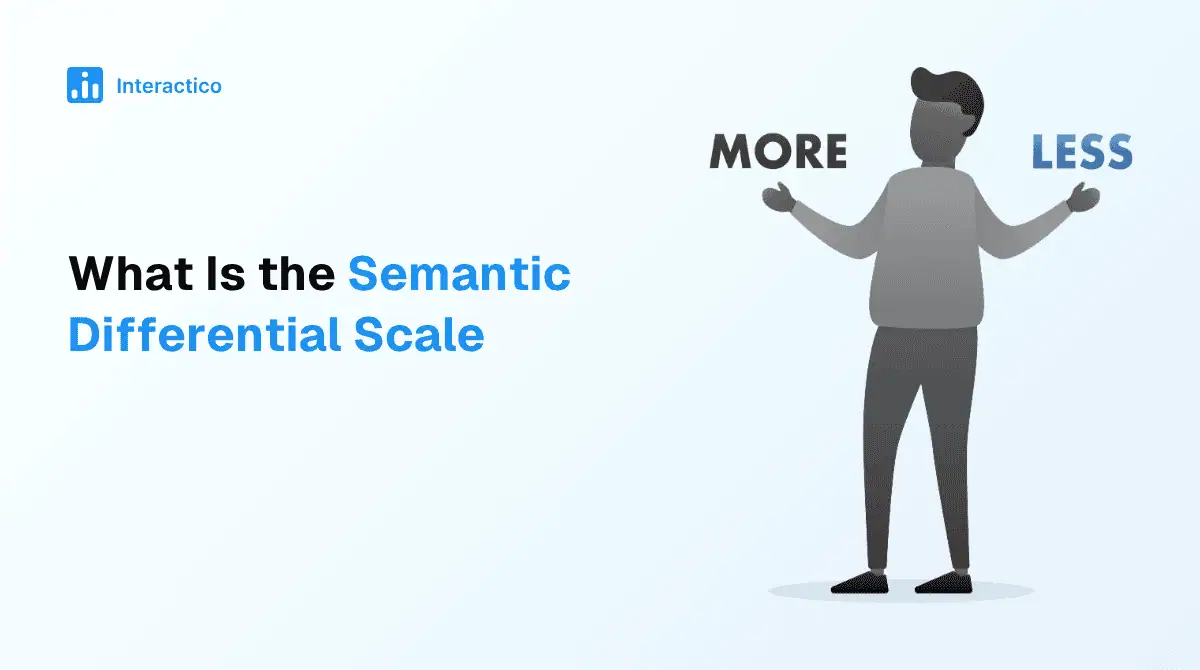
What Is the Semantic Differential Scale?
It is a type of rating scale used to measure a person’s attitude, perception, or emotional response toward a concept/product/idea. So, instead of asking direct questions, it presents two opposite adjectives at each end of a scale, such as:
Helpful 1 — 2 — 3 — 4 — 5 Unhelpful
Respondents select a point that best represents their opinion. This method provides better insights compared to traditional survey formats.
What Are the Core Dimensions of the Semantic Differential Scale?
Research by Charles E. Osgood identified three universal dimensions that shape how people interpret meaning across cultures. These three dimensions form the foundation of most semantic differential scales used in research and feedback systems:
-
Evaluation (Good vs Bad)
This dimension measures whether something is perceived positively or negatively.
Example: Pleasant — Unpleasant
-
Potency (Strong vs Weak)
This dimension evaluates the strength or power associated with a concept.
Example: Powerful — Powerless
-
Activity (Active vs Passive)
This dimension reflects the level of energy or movement linked to something.
Example: Energetic — Calm
What Are the Types of Semantic Differential Scale Questions?
Different formats of semantic differential scale questions allow flexibility based on the survey goal.
-
Slider Rating Scale
This is an interactive scale where users drag a slider between two opposite words (like Happy ↔ Sad). It feels more engaging and helps capture how strongly someone feels about something.
-
Non-Slider Rating Scale
This is a fixed scale (like 1 to 5 or 1 to 7) placed between two opposite words. Users simply pick a number, which makes it easy to answer and even easier to analyze.
-
Open-Ended with Scale Context
Here, you combine a scale with a follow-up question. First, users rate something, and then they explain why. This gives you both numbers and real insights.
-
Bipolar Adjective Scales
This is the most common type. You place two opposite words at each end (like Easy ↔ Difficult), and users pick where they stand in between. It helps measure opinions clearly.
-
Three-Dimensional Scale
This type of scale measures responses across three aspects at once:
- Is it good or bad?
- Is it strong or weak?
- Is it active or passive?
It gives a more complete understanding instead of just one perspective.
-
Satisfaction Rating Scale
This type of the semantic differential scale focuses specifically on satisfaction levels using opposite terms (like Satisfied ↔ Unsatisfied). It is commonly used in feedback forms and surveys.
How Does the Semantic Differential Scale Work?
Before you begin designing a scale of your own, you need to understand how the semantic differential scale actually works:
- Select a Concept: Start by identifying what you want to measure, such as a product, experience, or perception, so your scale stays focused and relevant.
- Choose the Right Bipolar Adjective Pairs: Choose clear opposite words (like easy to difficult) that accurately reflect the dimension you want to evaluate.
- Construct the Scale: Add a consistent numeric range (such as 1–5 or 1–7) between the adjectives to capture the intensity of opinions.
- Deploy the Survey: Present the scale in surveys or quizzes where respondents can quickly select their position without confusion.
- Analyze Accurately: Convert responses into numbers to identify patterns, averages, and trends across participants.
- Interpret Properly: Use the results to understand perceptions, compare responses, and make informed decisions based on real feedback.
What Are the Advantages of the Semantic Differential Scale?
- Ease of Interpretation: It converts subjective opinions into measurable values.
- Versatility: It can be used across industries like education, HR, and marketing.
- Quick Administration: Respondents can answer quickly without confusion.
- Nuanced Insights: It captures subtle differences in perception.
- Improved Response Accuracy: Respondents express opinions more precisely.
What Are the Use Cases of the Semantic Differential Scale?
-
Job Satisfaction Surveys
Human resources departments and organizational psychologists frequently use semantic differential scales to measure employee satisfaction and engagement. These help evaluate different aspects of the workplace in a structured yet flexible way.
- Work environment: Stressful 1 — 2 — 3 — 4 — 5 Relaxed
- Work-life balance: Poor 1 — 2 — 3 — 4 — 5 Excellent
- Career growth opportunities: Limited 1 — 2 — 3 — 4 — 5 Abundant
By using these insights, organizations can identify gaps, improve employee experience, and make informed decisions to boost retention and productivity.
-
Brand Perception
Another use case of these scales is in marketing teams. They can use them to understand how customers perceive a brand compared to competitors. This helps uncover emotional and psychological associations tied to branding.
- Brand image: Outdated 1 — 2 — 3 — 4 — 5 Modern
- Trustworthiness: Unreliable 1 — 2 — 3 — 4 — 5 Reliable
- Innovation: Traditional 1 — 2 — 3 — 4 — 5 Innovative
These insights help businesses refine their messaging, strengthen positioning, and align their brand with customer expectations.
-
Customer Satisfaction
Businesses rely on semantic differential scales to measure customer experiences in a more detailed way than simple ratings. These scales capture how customers truly feel about a product or service.
- Service quality: Poor 1 — 2 — 3 — 4 — 5 Excellent
- Support experience: Unhelpful 1 — 2 — 3 — 4 — 5 Helpful
- Ease of use: Complicated 1 — 2 — 3 — 4 — 5 Simple
This allows organizations to pinpoint exact pain points and improve overall customer satisfaction effectively.
-
Product Evaluation
Product teams can use these scale formats to test how users perceive features, usability, and overall product experience.
- Usability: Difficult 1 — 2 — 3 — 4 — 5 Easy
- Design: Unattractive 1 — 2 — 3 — 4 — 5 Attractive
- Performance: Slow 1 — 2 — 3 — 4 — 5 Fast
These responses help teams prioritize improvements and build products that align better with user expectations.
-
Employee Feedback
Organizations can even use scales to gather honest employee feedback about workplace culture, leadership, and communication.
- Management style: Unsupportive 1 — 2 — 3 — 4 — 5 Supportive
- Communication: Unclear 1 — 2 — 3 — 4 — 5 Clear
- Team collaboration: Weak 1 — 2 — 3 — 4 — 5 Strong
This helps leaders understand employee concerns and take actionable steps to improve engagement and morale.
-
UX Research
UX researchers apply semantic differential scales to evaluate how users interact with digital products and interfaces.
- Navigation: Confusing 1 — 2 — 3 — 4 — 5 Intuitive
- Interface design: Cluttered 1 — 2 — 3 — 4 — 5 Clean
- User experience: Frustrating 1 — 2 — 3 — 4 — 5 Enjoyable
These insights help designers create more user-friendly experiences and improve overall product usability.
Best Practices for Designing Effective Scales
To get the best results from semantic differential scales, follow these practices:
- Set Clear Instructions: Ensure respondents understand how to answer the scale correctly.
- Choose Tailored Adjectives: Choose relevant and meaningful word pairs.
- Use a Consistent Scale Format: Use the same format throughout the survey.
- Be Culturally Sensitive: Avoid terms that may confuse different audiences.
- Make the Best Use of Technology: Digital tools improve accuracy and ease of use.
- Plan Data Analysis: Decide how responses will be interpreted before collecting data.
- Review Regularly: Update scales based on feedback and evolving needs.
Create interactive, data-rich quizzes and feedback forms that capture deeper perceptions from learners and users with ease.

Conclusion
From capturing emotions to analyzing perceptions, semantic differential scales provide deeper insights that traditional methods often miss. Using this approach can significantly improve the quality of your feedback and decision-making.
The key is to design your scale thoughtfully, analyze it correctly, and use the insights to drive meaningful action.
FAQs:
How can a semantic differential scale improve surveys?
It improves surveys by providing more detailed responses instead of simple yes/no answers. This allows you to understand the intensity of opinions and gain deeper insights.
Where can semantic differential scales be used?
They can be used in education, market research, UX design, employee feedback, and customer satisfaction studies to understand perceptions and attitudes.
What is the primary purpose of a semantic differential scale?
The main purpose is to measure attitudes and perceptions in a structured way, helping researchers collect nuanced and meaningful data.
How do semantic differential scales help in market research?
They provide detailed insights into customer opinions, helping businesses identify strengths, weaknesses, and opportunities for improvement.