
A rating scale helps you gather opinions, experiences, and behaviors and turn those responses into data you can analyze. In this article, you’ll discover what exactly a rating scale is, its types, some practical examples, and the benefits of using it for data collection.
What Is a Rating Scale?
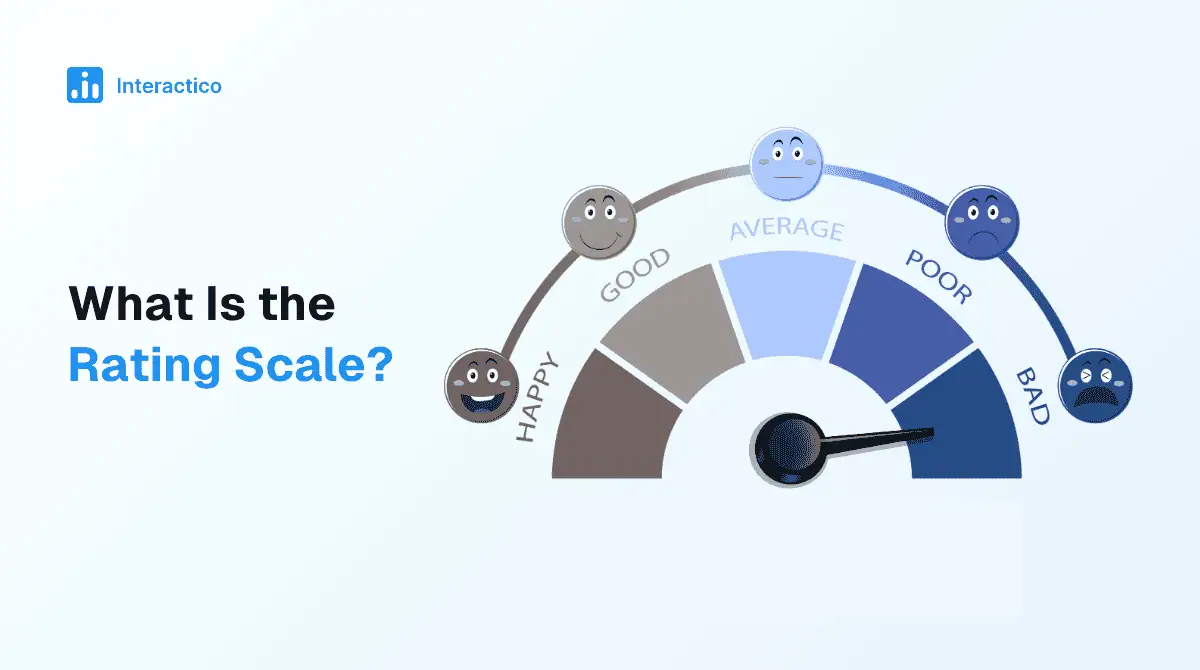
A rating scale is a survey tool used to measure opinions or behaviors by allowing respondents to select a value from a predefined range. It converts subjective responses into structured data that can be analyzed and compared.
These scales are widely used to evaluate customer satisfaction or employee performance. Instead of asking open-ended questions, they provide a consistent format that improves clarity and data reliability.
Why Use a Rating Scale?
- Quantifies Subjective Data: Rating scales convert opinions and perceptions into measurable data, making responses easier to analyze and interpret.
- Simplifies Data Analysis: They give structured responses that allow faster analysis compared to open-ended feedback, especially in large datasets.
- Easy to Use & Time-Efficient: Respondents can answer quickly without confusion, which improves completion rates.
- Enables Comparison & Benchmarking: Standardized scales allow you to compare results across time, groups, or different surveys.
- Supports Strategic Decision-Making: With a rating scale, you get clear data insights that help you make informed and data-driven decisions.
- Works Across Languages & Cultures: Rating scales come in different types and are extremely easy to use. Their simple formats make them adaptable for global audiences.
What Are the Types of Rating Scales?
1. Likert Scale
A Likert scale is a type of rating scale that asks people how much they agree or disagree with a statement. Instead of just answering “yes” or “no,” it gives multiple options so respondents can show the strength of their opinion.
Related Read: Likert Scale Questions to Measure Attitudes & Opinions
2. Numeric Rating Scale
A numeric rating scale is a type of rating scale where people answer a question by choosing a number from a fixed range, such as 1 to 5 or 1 to 10. Each number represents how strong their feeling or opinion is, with lower numbers indicating less and higher numbers indicating more.
3. Graphic Rating Scale
With a graphic rating scale, people choose their answer by marking a position on a visual line or bar instead of selecting a number or word. The position they choose shows how strongly they feel about something, from one extreme to another.
4. Descriptive Rating Scale
A descriptive rating scale uses clearly defined words instead of numbers to represent different levels of performance or opinion. It improves clarity and helps respondents understand each option easily.
5. Behavioral Rating Scale
A behavioral rating scale is a type of rating scale that measures performance based on specific, observable actions. Instead of asking how “good” someone is, it shows clear examples of behaviors at each level so people can rate more accurately.
Related Read: Rating Scale Questions
How to Use Rating Scales in Real-World Scenarios: Practical Examples
1. Customer Satisfaction Survey (Likert Scale Example)
You can use a Likert scale to measure customer opinions. It helps you capture how strongly customers agree or disagree with a statement. It is widely used because it converts subjective feedback into structured, easy-to-analyze data.
Examples:
- “The checkout process was smooth.”
Strongly agree / Agree / Neutral / Disagree / Strongly disagree
- “I am satisfied with the overall service.”
Strongly agree / Agree / Neutral / Disagree / Strongly disagree
- “I would recommend this product to others.”
Strongly agree / Agree / Neutral / Disagree / Strongly disagree
2. Employee Performance Review (Descriptive Scale Example)
A descriptive rating scale can help you evaluate employee performance using clearly defined labels instead of numbers. It makes it easier for evaluators to give feedback without needing precise scoring.
Examples:
- “Quality of work delivered”
Excellent / Good / Average / Poor
- “Ability to meet deadlines”
Outstanding / Meets expectations / Needs improvement
- “Team collaboration skills”
Strong / Moderate / Weak
3. Pain Assessment in Healthcare (Numeric Rating Scale Example)
A numeric rating scale measures intensity using numbers, usually on a fixed range like 0 to 10. It is especially useful when quick, consistent responses are needed across different individuals.
Examples:
- “Rate your pain level from 0 to 10.”
(0 = No pain, 10 = Worst pain imaginable)
- “How severe is your headache right now?”
Scale: 1 (Mild) to 10 (Severe)
- “How intense is your discomfort after treatment?”
Scale: 0 to 10
4. Employee Time Management (Graphic Rating Scale Example)
A graphic rating scale presents performance along a visual or structured range, such as colors, labels, or numbers. It helps evaluators quickly compare performance while maintaining consistency.
Examples:
- Color-coded scale:
“How effective is this employee at managing their time?”
- Green (Highly proficient): Always meets deadlines
- Light Green (Proficient): Usually meets deadlines
- Yellow (Average): Inconsistent time management
- Orange (Below average): Often misses deadlines
- Red (Poor): Consistently misses deadlines
- Label-based scale:
“How well does the employee adapt to changes?”
Excellent / Good / Fair / Poor
- Numeric visual scale:
“Rate the quality of work delivered.”
Scale: 1 (Very poor) to 10 (Exceptional)
5. Customer Service Performance (Behavioral Rating Scale Example)
A behavioral rating scale measures performance based on specific actions instead of general opinions. It provides clear descriptions, making feedback more objective and actionable.
Examples:
- “How effectively does the representative handle customer issues?”
- Resolves issues independently and efficiently
- Resolves most issues with some support
- Struggles to resolve issues without help
- “How does the employee communicate with customers?”
- Always communicates clearly and professionally
- Usually communicates well with minor gaps
- Often lacks clarity in communication
- “How does the employee handle difficult situations?”
- Stays calm and resolves issues proactively
- Manages situations with occasional support
- Struggles under pressure
Design smarter surveys and engage your audience effortlessly with Interactico.

Advantages & Disadvantages of Using a Rating Scale
Advantages
- Easy to Use & Understand: Rating scales are simple for respondents to answer and require minimal effort.
- Converts Subjective Data into Quantifiable Insights: They transform opinions into measurable values that can be analyzed.
- Uniformity: Consistent response formats improve reliability across surveys.
- Efficiency: They allow quick data collection and analysis at scale.
Disadvantages
- Limited Qualitative Insight: Rating scales may not capture detailed explanations behind responses.
- Halo Effect: Respondents may rate everything similarly based on one overall impression.
- Risk of Respondent Bias: People may choose extreme or neutral options without careful thought.
- Interpretation Variability: Different respondents may interpret scale points differently.
FAQs:
1. What is the most commonly used rating scale?
The Likert scale is the most commonly used rating scale because it is simple, flexible, and effective for measuring opinions and attitudes.
2. What is the difference between a rating scale and a ranking scale?
A rating scale allows respondents to evaluate each option independently, while a ranking scale requires them to arrange options in order of preference.
3. How many points should a rating scale have?
A 5-point scale works well for most surveys because it balances simplicity and accuracy, while a 7-point scale provides more detailed insights.
4. Can rating scales be used in qualitative research?
Yes, rating scales can be used in qualitative research alongside open-ended questions to provide measurable insights and deeper context.